Sunday, March 31, 2013
Saturday, March 30, 2013
Well, That Was A Long Break...
Not long after my November 10 blog entry, my father, age 90; fell coming out of the shower and couldn't get up. In his wisdom, he had taken his waterproof alarm off and laid it where he couldn't reach it and spent some 30 hours on the floor before staff at the lodge noticed he wasn't at dinner and came to check on him.
He was rallying quite well when he developed aspiration pneumonia and basically gave up. I think he realized he wasn't going to regain his indepenence.
Anyway, I spent much of November and December in Edmonton at the hospital and he died January 1. It's really only this last week or so that I am feeling better and at least a little ambitious.
Almost no photography has been done during this time but this week, fed up with being unable to supply clients with large prints, I finally picked up that D800E I'd been considering, and have been having some fun with it this weekend.
My arthritis is still limiting my walking so I picked up some peppers to photograph - hardly original but also challenging. Tomorrow I get brave and cut them open to see what can be made of the interiors.
I have the sigma 35 f1.4, Nikkor 85 1.4, two superb lenses, but also the Nikkor 200 micro as well as the 70-200. This latter I was prepared to return, but so far the results are quite good and I wonder if I even need the 85. I do like the micro nikkor for close work though and will hang on to that.
I did make one image in January, from some flowers my sister sent me in lieu of the gorgeous flowers at Dad's memorial that I couldn't bring home to Calgary.
He was rallying quite well when he developed aspiration pneumonia and basically gave up. I think he realized he wasn't going to regain his indepenence.
Anyway, I spent much of November and December in Edmonton at the hospital and he died January 1. It's really only this last week or so that I am feeling better and at least a little ambitious.
Almost no photography has been done during this time but this week, fed up with being unable to supply clients with large prints, I finally picked up that D800E I'd been considering, and have been having some fun with it this weekend.
My arthritis is still limiting my walking so I picked up some peppers to photograph - hardly original but also challenging. Tomorrow I get brave and cut them open to see what can be made of the interiors.
I have the sigma 35 f1.4, Nikkor 85 1.4, two superb lenses, but also the Nikkor 200 micro as well as the 70-200. This latter I was prepared to return, but so far the results are quite good and I wonder if I even need the 85. I do like the micro nikkor for close work though and will hang on to that.
I did make one image in January, from some flowers my sister sent me in lieu of the gorgeous flowers at Dad's memorial that I couldn't bring home to Calgary.
Saturday, November 10, 2012
A bronze propeller (ship's screw) found at the Esquimault Naval Base near Victoria. On each blade, one side had been buffed, the other left corroded. I elected to let the image blur in places and it's a 5 image stitch (as I usually do when making panoramas, hating to crop, even with a 22 megapixel camera. I did use some Akvis Enhancer but toned it back to a maximum of about 45% and then used masking to reduce the effect further as appropriate. It helped add the third dimension back, while masking prevented loss of the softness of parts of the image.
Friday, November 02, 2012
Agave
Agave plant from Butchart Gardens, Victoria, B.C. photographed in the rain with my 5D3 which held up very well over several hours of rain.
Monday, October 08, 2012
Saturday, October 06, 2012
Sunday, September 30, 2012
Dinosaur Provincial Park 2012
Went down yesterday afternoon to catch the evening light, stayed overnight in Brooks and got up early to be there at dawn. This was a single image. Made with my 17-40 @ 17 mm.
Sunday, September 23, 2012
Fall Colours
Canon 5D3, Lensbaby Composer, extension tube, and the only editing was to turn down the green a tad, otherwise colour as shot. Be sure to click on it to see in larger size.
Monday, September 10, 2012
HIgh ISO
The Stream and Pool image I posted last night was shot at ISO 1600. I would have never considered this high an ISO in the past but my new 5D3 handles it with aplomb and 17X22 prints should not be a problem. I did it because I could see that on the LCD screen, the ISO 100 pictures had very blurred out water totally devoid of the lovely reflections I was seeing. Even 800 didn't help but ISO 1600 and 1/8 of a second at f11 solved my problem. My intent was to use the ISO 100 images as a focus blend in Helicon Focus, then use one of the ISO 1600 images for just the water, but in the end simply blended the ISO 1600 images because they looked so good, then used one of those images for the pond water, and another for the further stream (moving water doesn't go well with focus blending).
The times and equipment are great.
Sunday, September 09, 2012
Saturday, September 08, 2012
Back To Jura Canyon
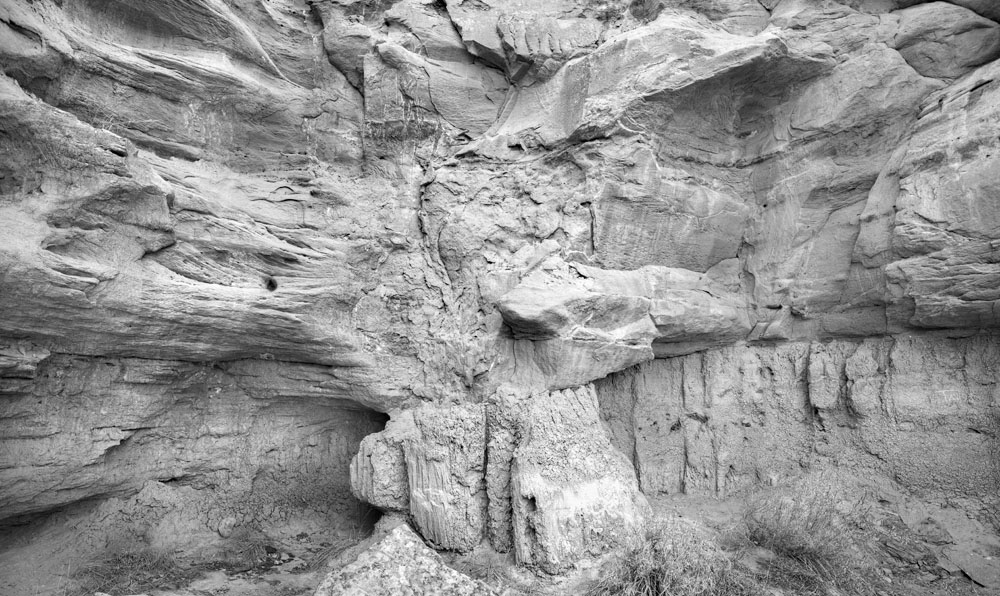
Shot this evening. I think everything you see here is natural rather than pictogryphs, though I find the image a little mystical.
Sunday, August 26, 2012
Cowboys
These three images were made on a workshop this weekend with William Allard, he of National Geographic fame. It was arranged through The Camera Store here in Calgary (that's what it's called), and we met with Bill Friday night to dicsuss what was going to happen, then met west of Longview and switched to four wheel trucks to head up to a branding camp, used only a couple of times a year.
The local ranchers rode in and gave of their day to pose, and ride, and pose some more. These are real working cowboys, two grand parents, his brother, and their two grand daughters.
The workshop was a great success and we met this morning for critiques of the images. I found the experience great as others had ideas I'd poo pooed but they'd made it work, or I hadn't even thought of, or they did a better job shooting action (not my forte). Anyway a terrific weekend, Bill is great and sharing and helpful and I hope to see him again.
Monday, August 13, 2012
Drain Pipe Continued
This is the version that was not lightened for making the print - despite best efforts to profile monitor and printer and correct screen brightness, the shadows were too deep in the print and I'd added a lightening curve. This is what it was before and is much closer to what I wanted.
And here is what the image looks like in black and white. Now to decide which I prefer. Not easy.
Sunday, August 12, 2012
Drain Pipe Cropped
I'm quite pleased with the print I made from the version above. As usual, the thrill of making the image tends to ignore any flaws it may have and it might not hold up over the next few weeks, or I might like it more and more. Sometimes you realize it's just silly, or perhaps clever but absolulely nothing else - no soul - always a risk with this kind of image. Other times it acquires more meaning or more emotion, or makes you think of connections, contrasts, or similes.
People tend to assume that these relationships that make an image for the artist remain constant, but in fact there are many examples of artists providing alternate explanations for an image's value years later, as their circumstances, experiences and mood change. It isn't a big step further then to imagine that the viewer brings their own circumstances etc. to seeing the print and those experiences may be entirely different from what the photographer had, or planned, or anticipated.
And guess what, that's entirely as it should be.
And below, the original full frame image:
Both are focus blends of half a dozen images, 24-70 L, Canon 5D3, Helicon Focus for the blending, processed in Lightroom 4 and exported to Photoshop for additional work
Bent Drain Pipe
Highway construction dug up and folded this drainpipe. The side I had seen from the road the previous day was good, the view along the bent pipe better, but the far side, that I had not expected anything from and only checked to be complete, revealed this fascinating combination.
As it stands, I think the composition too complex and while I didn't want to throw away anything, I suspect the image might be better without the top. It reminds me of a carnivorous plant. Stay tuned for further developments.
Thursday, July 26, 2012
On Landscape - the Online Magazine
Tim Parkin who did the work on comparing landscapes shot with 8X10, 4X5, IQ 180 and even the Sony 900 earlier this year continues to publish the online magazine On Landscape.
It's quite expensive and I think many will reject it out of hand without thinking about just what it's giving us.
There have been technical articles like the above - a huge and very useful achievement, as well as quite indepth discussions by real photographers on the art of photography - as well as book reviews and portfolios.
Given the videos alone, and coming every couple of weeks as it does, this makes the sign up cost pretty darn reasonable - $100 approx. for 26 issues - but that's $4 an issue, no advertizing to pile through, useful stuff in every issue - I think well worth the expense. It's nicely set up so you can see the beginning of many of the articles without signing up - so do check it out, and consider subscribing as I have done.
It's quite expensive and I think many will reject it out of hand without thinking about just what it's giving us.
There have been technical articles like the above - a huge and very useful achievement, as well as quite indepth discussions by real photographers on the art of photography - as well as book reviews and portfolios.
Given the videos alone, and coming every couple of weeks as it does, this makes the sign up cost pretty darn reasonable - $100 approx. for 26 issues - but that's $4 an issue, no advertizing to pile through, useful stuff in every issue - I think well worth the expense. It's nicely set up so you can see the beginning of many of the articles without signing up - so do check it out, and consider subscribing as I have done.
Sunday, July 22, 2012
Michael Reichmann
Sad news today that Michael has been ill with bladder cancer and is now recovering from major surgery. I wish him the speediest recovery and best wishes for his future health.
I've met Michael a couple of times - attending his Algonquin workshop one year and then the very first Podas workshop in Death Valley - a friendly, helpful man, an excellent teacher, and fun. His Luminous Landscape has been the go-to website for information on equipment and technique for years.
Michael published my 'Take Your Photography To The Next Level' series of articles that led to me being offered a book deal by Rockynook Publishers. Michael's review of 'Why Photographs Work' gave huge boost to sales around the world.
Michael's videos have been of tremendous help and are one of my most often recommended tools. His original and then new 'From Camera To Print (and Screen) were fun, entertaining and incredibly helpful.
Truth is, we need Michael, so all the best to you my friend, for the pleasures given, and those anticipated.
George
I've met Michael a couple of times - attending his Algonquin workshop one year and then the very first Podas workshop in Death Valley - a friendly, helpful man, an excellent teacher, and fun. His Luminous Landscape has been the go-to website for information on equipment and technique for years.
Michael published my 'Take Your Photography To The Next Level' series of articles that led to me being offered a book deal by Rockynook Publishers. Michael's review of 'Why Photographs Work' gave huge boost to sales around the world.
Michael's videos have been of tremendous help and are one of my most often recommended tools. His original and then new 'From Camera To Print (and Screen) were fun, entertaining and incredibly helpful.
Truth is, we need Michael, so all the best to you my friend, for the pleasures given, and those anticipated.
George
Big Hill Springs Provincial Park
Shot this morning with my new 24 ts-e tilt and shift lens, taking advantage of the left and right shift.
I'd arrived before sunrise but by the time I'd photographed for about 30 minutes, the sun was coming over the hill (guess getting up at 5 was a bit late). The only image made before the sun came out that had any real possibilities was spoiled by incorrect use of the tilt. I'm so used to the 90 tilt where a small amount of tilt goes a fair way. With this lens, a small amount of tilt is way too much, and unlike the 90, the 24 is quite hard to focus - clearly it's going to take me some practice with this lens.
And here's the black and white version.
And if any of you have been following my search for the ideal high pixel count camera, you will remember I had placed an order for the D800E a few months ago. No sign of it arriving and in the mean time spent months pouring over what lenses I'd want to use, using the-digital-picture.com, diglloyd.com, photozone.de and lensrentals.com to help me pick lenses.
I hated to lose my 70-200 f4 L IS lens - not only was the nikon 2.8 going to be heavier, it tested not quite as sharp at the long end. Then I thought, I'd need to replace my extension tubes, and oh yes, my lensbaby composer. The last straw was realizing all my filters including my very expensive variable neutral density filter weren't going to fit. I came up with a dozen different lens combinations, all of them costing an absolute fortune, easily enough to pay for the Pentax 645D that I'd choked on.
I ended up with a list of 8 things I didn't like, or didn't like the reports of the D800E.
They were:
1) mechanical first shutter curtain in live view - with some reports of image blur because of it - the Canon 5D2 and 3 are pure electronic - absolutely no vibration till the shutter closes.
2) the delay in using live view - sure it was only five seconds between image and probably less with good cards, but when I'm stitching, or focus blending, this is way frustrating.
3) Eye relief for glasses, 17 vs. 21 mm. - not a lot but things were already tight seeing the entire viewfinder on the 5D2...
4) Cost of lenses, and the fact that at some focal lengths, just not as good as canon. Sure I could get Zeiss glass, but guess what - my new 24 ts-e tests as well or better than the Zeiss 21 - and without the mustache distortion.
5) focus problems - with some of the d800/e - not a huge deal for me
6) quality of live view - even at 100% it isn't as good as canon - and that was something I really liked about moving from the 1DsII to the 5D2.
7) the 3:2 lcd screen on the Canon meant bigger images on the screen - again hardly a deal breaker, but nice.
8) Having to learn to focus a different way, and have entirely different controls - I quite like the Canon way. Sure I could learn, but why should I?
No question, 30% more resolution with the D800E sure was attractive, and two more stops dynamic range was appealing too - though I'd never complained about the 5D2 - and the image from today is a fine example of that, with considerable adjustment to open up the shadows and control the highlights without any difficulty or problem - fact is I shot the two stitches with two different exposures intending to exposure blend then stitch, but in the end it proved unncessary. The Canon is more forgiving at the top end, Nikon a lot more forgiving at the bottom end.
The final factor is that I would be extremely surprised if Canon doesn't come out with a high megapixel camera within the next year. I'm selling my 5D2, have already picked up a 5D3 and it will do me just fine till a better Canon option comes along.
It's been two weeks and so far I haven't regretted the decision.
Thursday, July 05, 2012
Photography as Puzzle Solving
There's lots of reasons to be a photographer, the need to create, the enjoyment of being outdoors (and now an excuse to be there instead of at home with the job jar), the love of the fine image and so on.
I wonder though if an important reason doesn't have more to do with the challenge of solving puzzles. In the old days this could be the challenge of producing good images from a wet darkroom - and perhaps explains the obsession of many with ultimate quality, finest grain, best developers etc. These days with the technical aspects of photography easier, the puzzle is more in the finding and framing of the fine image.
This starts with choosing the subject in general terms, planning where to go and when, and then finding the scene and deciding what you are going to do with it, and then moving into a position that best helps you tell your story or make your point or simply show what you are most interested in about the subject in the best way possible such that the viewer can best appreciate what interested you.
This business of puzzle solving perhaps explains the phenomenon of the lone worker who doesn't share his work, doesn't even put it on the wall, and files away the images. The hunt, the solving of the puzzle is the quest, not the actual final image.
Yes, but so what - how does thinking of photography as puzzle solving help me make better photographs, or enjoy my craft more?
Well, for a start, it may suggest that subject matter isn't nearly as important as you thought. Sure you do landscapes, because that's what you have always done, but if the chase is the thing, the puzzle solving the satisfaction, then might not just about any subject provide the same thrills and satisfactions. Instead of agonizing over whether photographing someone else's creation is valid, just go out and photograph architecture or even sculpture for the challenge and let the final print be a validation of that challenge successfully met.
I've just signed up for a workshop on photographing cowboys - about as far away from my usual subject matter as one could get (I'm guessing I won't need my tripod). I have no special interest in cowboys but think the challenge will be satisfying - making decisions on the fly, in a split second, and being able to predict the action so as to be in the right place ad the right time. So this is a new puzzle for me to solve.
One can appreciate the puzzle solving involved in photographing, for example a particular sport, even though one has no special interest in that sport - either watching or participating, because we like solving the puzzle of getting the best images.
The world has no use for any more cute cat pictures, but truth is getting good cat pictures can be extremely challenging and success in doing so very satisfying and does it really matter if the world doesn't beat a path to your door to appreciate your images.
This puzzle solving tends to take away from the feeling that we must produce images that others appreciate and frees us to work on what we want or find satisfying.
Perhaps this explains the fascination with Holga cameras and home made lenses and limiting oneself to a single lens or only black and white or learning to solve the puzzle of effective use of the Lensbaby.
Socrates referred to the unexamined life as being 'not worth living' which is perhaps a tad harsh, yet understanding the motives behind what we do can be illuminating (sorry).
As a physician, I work with people who have ADHD, and while helping them with the right combination of medications is satisfying, sometimes the most useful thing I can do is help explain why the patient makes the choices they do - the education path, the job, or even who they are attracted to. That 'Ahah' moment helps them make future decisions.
Why do you photograph?
I wonder though if an important reason doesn't have more to do with the challenge of solving puzzles. In the old days this could be the challenge of producing good images from a wet darkroom - and perhaps explains the obsession of many with ultimate quality, finest grain, best developers etc. These days with the technical aspects of photography easier, the puzzle is more in the finding and framing of the fine image.
This starts with choosing the subject in general terms, planning where to go and when, and then finding the scene and deciding what you are going to do with it, and then moving into a position that best helps you tell your story or make your point or simply show what you are most interested in about the subject in the best way possible such that the viewer can best appreciate what interested you.
This business of puzzle solving perhaps explains the phenomenon of the lone worker who doesn't share his work, doesn't even put it on the wall, and files away the images. The hunt, the solving of the puzzle is the quest, not the actual final image.
Yes, but so what - how does thinking of photography as puzzle solving help me make better photographs, or enjoy my craft more?
Well, for a start, it may suggest that subject matter isn't nearly as important as you thought. Sure you do landscapes, because that's what you have always done, but if the chase is the thing, the puzzle solving the satisfaction, then might not just about any subject provide the same thrills and satisfactions. Instead of agonizing over whether photographing someone else's creation is valid, just go out and photograph architecture or even sculpture for the challenge and let the final print be a validation of that challenge successfully met.
I've just signed up for a workshop on photographing cowboys - about as far away from my usual subject matter as one could get (I'm guessing I won't need my tripod). I have no special interest in cowboys but think the challenge will be satisfying - making decisions on the fly, in a split second, and being able to predict the action so as to be in the right place ad the right time. So this is a new puzzle for me to solve.
One can appreciate the puzzle solving involved in photographing, for example a particular sport, even though one has no special interest in that sport - either watching or participating, because we like solving the puzzle of getting the best images.
The world has no use for any more cute cat pictures, but truth is getting good cat pictures can be extremely challenging and success in doing so very satisfying and does it really matter if the world doesn't beat a path to your door to appreciate your images.
This puzzle solving tends to take away from the feeling that we must produce images that others appreciate and frees us to work on what we want or find satisfying.
Perhaps this explains the fascination with Holga cameras and home made lenses and limiting oneself to a single lens or only black and white or learning to solve the puzzle of effective use of the Lensbaby.
Socrates referred to the unexamined life as being 'not worth living' which is perhaps a tad harsh, yet understanding the motives behind what we do can be illuminating (sorry).
As a physician, I work with people who have ADHD, and while helping them with the right combination of medications is satisfying, sometimes the most useful thing I can do is help explain why the patient makes the choices they do - the education path, the job, or even who they are attracted to. That 'Ahah' moment helps them make future decisions.
Why do you photograph?
Subscribe to:
Posts (Atom)