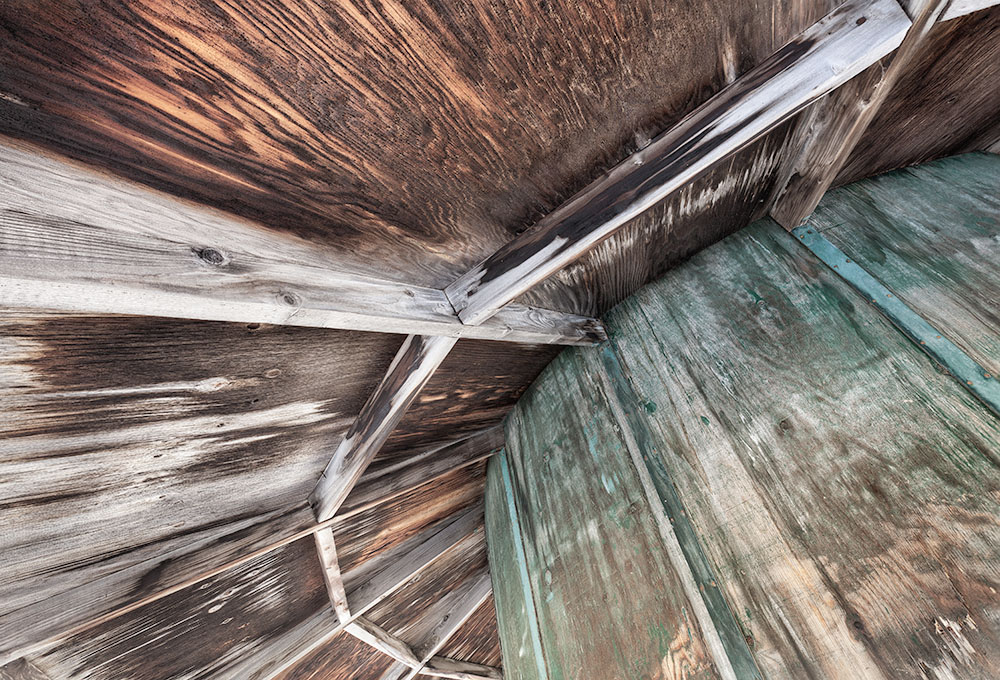
A couple of years ago I attempted to photograph this cattle feeder, sitting lonely and decaying in a field, and came away with nothing - the shapes were interesting but the holes in the side exposed bright snow, and I just couldn't come up with anything.
Today, I decided to look up, and with a wide angle lens, was able to make an interesting composition. Not a really good photograph, simply a competent one.
Saturday, December 31, 2011
Tuesday, December 27, 2011
An Image From A Collection Is Not Made
Sometimes a group of image elements simply does not come together to make an image. As a postage stamp this looks quite nice but once seen at any reasonable size, there is too much clutter, too much distraction, and too much rust all roughly the same brightness for the image to work.
Various attempts at cropping this conglomeration just make the situation worse. Just possibly it might come together in better lighting, though I wouldn't count on it. Every attempt to simplify the composition also weakens it.
I spent a couple of hours working on this, as the light was failing and in which by the end I could not keep the exposure to 30 seconds without increasing the iso.
The shapes and textures were so intriguing I was determined to find a away to make a successful image, but in the end failed.
The angled shot below, combined with some dodging and burning, and some local contrast enhancement, was the best I could come up with but I'm not satisfied.
Realistically, not every setup is going to work, and it is well worth trying a few setups in any single shoot, so that you have a reasonable chance of coming home with something pleasing, if not actually wonderful.
Too many unpleasing shoots in the past have made me give up photography for as many at 15 years at a time. Of course, this was in the days of film, and many times a single setup, albeit with several framings and positionings, was about all one could achieve. Some find the change to be outside and puttering or hiking a reward in itself but I confess, for me, that was never enough - I wanted decent images to make the effort wortwhile, and I'm sure a lot happier photographer since switching to digital specifically for the ability to cover a few scenes in an afternoon.
If you are shooting digitally but continue to put all your eggs in one basket ...
Various attempts at cropping this conglomeration just make the situation worse. Just possibly it might come together in better lighting, though I wouldn't count on it. Every attempt to simplify the composition also weakens it.
I spent a couple of hours working on this, as the light was failing and in which by the end I could not keep the exposure to 30 seconds without increasing the iso.
The shapes and textures were so intriguing I was determined to find a away to make a successful image, but in the end failed.
The angled shot below, combined with some dodging and burning, and some local contrast enhancement, was the best I could come up with but I'm not satisfied.
Realistically, not every setup is going to work, and it is well worth trying a few setups in any single shoot, so that you have a reasonable chance of coming home with something pleasing, if not actually wonderful.
Too many unpleasing shoots in the past have made me give up photography for as many at 15 years at a time. Of course, this was in the days of film, and many times a single setup, albeit with several framings and positionings, was about all one could achieve. Some find the change to be outside and puttering or hiking a reward in itself but I confess, for me, that was never enough - I wanted decent images to make the effort wortwhile, and I'm sure a lot happier photographer since switching to digital specifically for the ability to cover a few scenes in an afternoon.
If you are shooting digitally but continue to put all your eggs in one basket ...
Image Quality
Recently Luminous Landscape published a comparison of the IQ180 top of the line digital back from PhaseOne with 8X10 colour film. It seemed odd at the time that the fellow setting this up reasoned that one could scan 8X10 film at 750 pixels per inch and get all the information that was available in the film.
It seemed odd, because if one uses the same emulsion in 35 mm. film, scanning a slide or colour negative at only 750 pixels per inch would be a disaster, showing only a small fraction of the information in the original.
Tim Parker and friends have taken on the daunting task of doing a repeat and extension of this comparison, adding 4X5 film, and the older P45 back (?39 megapixels vs. 80 for the newest), as well as Canon 5D2 (of great interest to me) and the Sony 900.
The results of the studio shots showed a huge advantage to the 8X10 film, and even to 4X5 and the Mamiya 7. A shot out in the wild however tended to even things out. Despite very windy conditions, they continued to show a huge resolution advantage to the 8X10 transparency film, but when it came to looking at the darker areas of the image, a whole other story came out.
It seemed odd, because if one uses the same emulsion in 35 mm. film, scanning a slide or colour negative at only 750 pixels per inch would be a disaster, showing only a small fraction of the information in the original.
Tim Parker and friends have taken on the daunting task of doing a repeat and extension of this comparison, adding 4X5 film, and the older P45 back (?39 megapixels vs. 80 for the newest), as well as Canon 5D2 (of great interest to me) and the Sony 900.
The results of the studio shots showed a huge advantage to the 8X10 film, and even to 4X5 and the Mamiya 7. A shot out in the wild however tended to even things out. Despite very windy conditions, they continued to show a huge resolution advantage to the 8X10 transparency film, but when it came to looking at the darker areas of the image, a whole other story came out.
You must click on the image above to see it at proper size. As you can see, the amount of detail in the IQ180 on the right is huge, however if one is honest, there is over sharpening and in the areas of the left that are adequately exposed and standing still, there is a lot of detail.
This example above was deliberately selected to show the film results at their worst - in shadowed areas and dealing with more wind than most of us are willing to put up with.
Again, click to see at original size - and the sharpening is the same as in the shadow image. There is a tremendous amount of information in the distant trees and buildings and bridges beyond that is simply gone in the digital image.
A different image of the skyline shows more detail in the film image no matter what sharpening is applied to the digital image, though with a huge amount of sharpening (6 pixels worth) you can see at least some of what the film saw, but that amount of sharpening destroys the rest of the image).
Bottom line is under ideal circumstances, optimal stop, no wind, rock steady tripod and great lenses, 8X10 still very nicely remains King Of The Hill.
Under real circumstances, it isn't nearly as clear - more of a matter of losing on the straightaways and winning on the corners. This would explain Hans Strand's comment that since switching to a Hasselblad 50 MP camera, he has seen a significant increase in quality of his images - real images in real situations.
For those who carefully select their situations, use a massive tripod and a low contrast lighting situation, and who then use careful unsharp masking in their printing, 8X10 is still capable of the ultimate in quality in 2011. This explains why people like Christopher Burkett are still willing to lug around his 15 lb. Calumet view camera. For those who climb active volcanoes, or fly over river deltas or climb into caves, like Hans, he is simply more successful with digital.
The original Tim Parkin study is available free at On Landscape and I encourage you to read it carefully, and possibly play with the images there for yourself. Although this online magazine leans towards British Landscape Photography, I note the inclusion of more international work since its inception and I'm going to subscribe.
Monday, December 19, 2011
And So It Begins - New Cameras
I'm not surprised to read this morning that a rumoured D800 is coming and the predictions are for a 36 mp sensor, with or without low pass filter. Once an official announcement is made, we can anticipate that Canon won't be far behind with something.
The 5D2 has been notoriously "un" waterproof though I must say I have had no diff. using it in the rain and snow. If Canon is to no longer make a high megapixel 1Ds series camera for the most demanding landscape shooters, one would hope they'd do something to toughen the 5D series.
Of course, there were lots of rumours the 1Dx was going to be 40+ megapixels so who really knows. I'm a little relieved I didn't get the 645D - for a functional lifetime of only a year or so (until a 5D2 replacement not only is announced but released and reviewed and found to be suitable).
So:
a wish list for the 5D2 replacement (this is my list, yours might be different for totally valid reasons).
1) lots of pixels - given that doubling the pixels only increases linear print size by 1.41, at least double is what I'd want.
2) no fuzzy (low pass) filter - I can deal with moire as needed. Interestingly, the colour image I showed in the last blog entry, of Horton Cantracting shows sig. moire in the print but not on screen, due to the lines in the asphalt siding. I once before had this problem photographing some lathed metal objects in which the lines from the cutting tool drove the print driver crazy. A slight blurring of the image solved he problem nicely and didn't affect print quality. Again, there was nothing wrong with the image at 100% mag. on screen.
3) tilting LCD screen - to enable high shots and make low shots more comfortable (no more belly to the ground).
Now, if I really had carte blanche for the design, how about a focus blending routine that could move focus between two predetermined points, amount a function of the lens and distance and f stop, with enough time between exposures to settle any shutter shake - ok, I know, not likely any time soon, but a guy can dream, can`t he.
Which reminds me. A long time user of Helicon Focus, it hasn`t been working for me for about three months - resulting in double and tripple images in places as it struggles to resize the image properly.
Unfortunately, at the same time, since switching to Photoshop CS5, I keep getting ``can`t find the javascript`` errors for many of my automate routines, and since going to cs5, I have also lost the ability in Bridge to access photomerge etc. - probably the same problem.
I was however able to use the auto align and auto blend features under edit in photoshop to properly focus blend the images. I don`t know why Helicon isn`t working for me any more - presumably one of the many updates has somehow changed things or lost a setting. Im using the default settings and the Lanczos 3X3 processing method as before.
If anyone has any brilliant suggestsions for these three problems, I`m listening.
George
The 5D2 has been notoriously "un" waterproof though I must say I have had no diff. using it in the rain and snow. If Canon is to no longer make a high megapixel 1Ds series camera for the most demanding landscape shooters, one would hope they'd do something to toughen the 5D series.
Of course, there were lots of rumours the 1Dx was going to be 40+ megapixels so who really knows. I'm a little relieved I didn't get the 645D - for a functional lifetime of only a year or so (until a 5D2 replacement not only is announced but released and reviewed and found to be suitable).
So:
a wish list for the 5D2 replacement (this is my list, yours might be different for totally valid reasons).
1) lots of pixels - given that doubling the pixels only increases linear print size by 1.41, at least double is what I'd want.
2) no fuzzy (low pass) filter - I can deal with moire as needed. Interestingly, the colour image I showed in the last blog entry, of Horton Cantracting shows sig. moire in the print but not on screen, due to the lines in the asphalt siding. I once before had this problem photographing some lathed metal objects in which the lines from the cutting tool drove the print driver crazy. A slight blurring of the image solved he problem nicely and didn't affect print quality. Again, there was nothing wrong with the image at 100% mag. on screen.
3) tilting LCD screen - to enable high shots and make low shots more comfortable (no more belly to the ground).
Now, if I really had carte blanche for the design, how about a focus blending routine that could move focus between two predetermined points, amount a function of the lens and distance and f stop, with enough time between exposures to settle any shutter shake - ok, I know, not likely any time soon, but a guy can dream, can`t he.
Which reminds me. A long time user of Helicon Focus, it hasn`t been working for me for about three months - resulting in double and tripple images in places as it struggles to resize the image properly.
Unfortunately, at the same time, since switching to Photoshop CS5, I keep getting ``can`t find the javascript`` errors for many of my automate routines, and since going to cs5, I have also lost the ability in Bridge to access photomerge etc. - probably the same problem.
I was however able to use the auto align and auto blend features under edit in photoshop to properly focus blend the images. I don`t know why Helicon isn`t working for me any more - presumably one of the many updates has somehow changed things or lost a setting. Im using the default settings and the Lanczos 3X3 processing method as before.
If anyone has any brilliant suggestsions for these three problems, I`m listening.
George
Saturday, December 17, 2011
Well, I Didn't Get the 645D
I was still uncertain as I drove to the store to return the loaned 645D and decided that I needed more certainty.
The issues were the money ($10,000), the lack of live view (I do a lot of focus blending), that with only the eyepiece I compromised flexibility at a time when I could really use a tilting LCD and live view to further flexibility, and a careful analysis of my own images with the camera and those available on the net to compare. I made prints and found I couldn't see a difference until I got up over 20X30 inches.
Today, I went out with the 5D2, and as dusk fell and I couldn't see through the viewfinder and as exposures moved towards 30 seconds and still live view worked well, I realized another advantage of live view.
Below are the images from this afternoon. The first had my 70-200 almost touching a chain link fence and there was a bit of fiddling to remove the hazy image of the wire. This was part of the demolished grain terminal in Calgary I had photographed before as it was being demolished.
The issues were the money ($10,000), the lack of live view (I do a lot of focus blending), that with only the eyepiece I compromised flexibility at a time when I could really use a tilting LCD and live view to further flexibility, and a careful analysis of my own images with the camera and those available on the net to compare. I made prints and found I couldn't see a difference until I got up over 20X30 inches.
Today, I went out with the 5D2, and as dusk fell and I couldn't see through the viewfinder and as exposures moved towards 30 seconds and still live view worked well, I realized another advantage of live view.
Below are the images from this afternoon. The first had my 70-200 almost touching a chain link fence and there was a bit of fiddling to remove the hazy image of the wire. This was part of the demolished grain terminal in Calgary I had photographed before as it was being demolished.
Wednesday, December 14, 2011
Decision Day
I have to finally decide - do I get the Pentax 645D now, or wait for an unknown unannounced camera which may or may not be made, and may or may not be suitable for my needs, and may or may not require a whole new set of higher quality lenses than I currently use on the Canon 5D2.
There have been comments from Canon that with the 1DX only being 18 mp, they are in no rush to produce a higher resolution camera, but it may all come down to what Nikon does. If they do produce the rumoured 36 MP camera, this will push Canon to do something similar.
It occurred to me that Canon may well have a 5D3 or equivalent in the wings, with more than one possible sensor, to be switched in shortly before mass production as needed depending on which way Nikon goes.
Manufacturers never put all their cards into one basket - it doesn't make economic sense, they need to have something in hand to justify the next model round the corner.
Adobe have been leading us on with hints of camera movement removal software in the next or next after Photoshop - just the same. Lightroom 3 doesn't have proofing, even though it's in Photoshop, so it isn't about can't, it's about when, and what will it take to persuade us to fork out money for the next iteration of camera or software.
So, what am I going to do?
Go with the Pentax. I have already ordered the used lenses, and a bird in the hand... and if in a year, or two, there are better cameras than the Pentax and I can't sell the used Pentax and lenses for more than $5000 total, well I will still hopefully have some great images that can make large prints without excuses. if the camera pays for itself in that time (in terms of sales of large images), well so much the better.
George
There have been comments from Canon that with the 1DX only being 18 mp, they are in no rush to produce a higher resolution camera, but it may all come down to what Nikon does. If they do produce the rumoured 36 MP camera, this will push Canon to do something similar.
It occurred to me that Canon may well have a 5D3 or equivalent in the wings, with more than one possible sensor, to be switched in shortly before mass production as needed depending on which way Nikon goes.
Manufacturers never put all their cards into one basket - it doesn't make economic sense, they need to have something in hand to justify the next model round the corner.
Adobe have been leading us on with hints of camera movement removal software in the next or next after Photoshop - just the same. Lightroom 3 doesn't have proofing, even though it's in Photoshop, so it isn't about can't, it's about when, and what will it take to persuade us to fork out money for the next iteration of camera or software.
So, what am I going to do?
Go with the Pentax. I have already ordered the used lenses, and a bird in the hand... and if in a year, or two, there are better cameras than the Pentax and I can't sell the used Pentax and lenses for more than $5000 total, well I will still hopefully have some great images that can make large prints without excuses. if the camera pays for itself in that time (in terms of sales of large images), well so much the better.
George
Monday, December 12, 2011
Image Quality
In checking into the Pentax 645D, I paid for a subscription to Digilloyd's Advanced Photography and noted his other site on image sharpness.
Below is a list of topics covered. I'm showing you this, not to promote the site (I haven't paid for this section of his site) but simply to point out the many ways an image can be degraded.
On his site, Lloyd has several examples of commonly used top brand lenses hugely changing focus as one stops down, the difference between focussing on the eyelashes and the tip of the nose or the ears type of difference.
I couldn't get a sharp image with the Phase one camera and P65+ back I borrowed for a workshop - and finally got rid of my centre post, tall ball head and leveling base that stuck up another two inches, and now I get sharp pictures consistently - if there is no wind.
On the 5D2, I have been utterly amazed at how much image blur there is at full magnification live view when the wind is blowing.
Michael Reichmann found that tripods (the best tripods) don't stop shaking for 7 seconds - using mirror lock up and a two second delay doesn't cut it.
With medium format especially, focal plane shutters can add considerably to the instability and I wouldn't be surprised if that wasn't a sig. part of my diff. with the phase one camera.
Camera straps blowing in the wind contribute to movement as do cable releases. Let's not even talk about people who press the shutter button and hope the camera stops shaking by the time the self timer activates.
I have been paying attention to what I stand on. Ground isn't ground - ground can be springy, it can be soggy or even squishy, it can be a connection between your feet and a tripod leg and there goes your image.
I`m amazed at how many people are still stopping down their camera to an f stop that is severely diffraction limited. With a full frame sensor (my 5D2) I usually use f11 and focus blend if I have to. Sometimes I will use f16. it isn`t as sharp, though I think I can pretty much compensate with local contrast enhancement. At f22, I can`t compensate. With an APS-C sensor, I try to stick to f11 at worst, and with point and shoots, even f8 can be problematic.
Below is a list of topics covered. I'm showing you this, not to promote the site (I haven't paid for this section of his site) but simply to point out the many ways an image can be degraded.
- Banish Blur, or Blur for Beauty?
- Blur by Focus
- Blur by Autofocus Error
- Blur by Manual Focus Error
- Blur by Manual Focus Inconsistency
- Blur by Focus Shift
- Blur by Focus Lock and Recompose (FLR)
- Blur by Subject Movement
- Blur by Camera Movement
- Blur by Mirror Slap
- Blur Caused by System Alignment
- Blur Caused by Image Stabilization
- Blur from Haze and Refraction
- Blur Caused by Lens Optics
- Blur and Haze from Spherical Aberration
- Blur by Purple Fringing (Axial Chromatic Aberration)
- Blur by Red/Cyan Fringes (Lateral Chromatic Aberration)
- Blur Caused by the Laws of Optics (Diffraction)
- Blur by Depth of Field
- Blur from Field Curvature
- Resolving to Sensor Resolution
- Blur Caused by Anti-Aliasing Filter
- Blur Caused by Digital Capture
- Blur Caused by Demosaicing
On his site, Lloyd has several examples of commonly used top brand lenses hugely changing focus as one stops down, the difference between focussing on the eyelashes and the tip of the nose or the ears type of difference.
I couldn't get a sharp image with the Phase one camera and P65+ back I borrowed for a workshop - and finally got rid of my centre post, tall ball head and leveling base that stuck up another two inches, and now I get sharp pictures consistently - if there is no wind.
On the 5D2, I have been utterly amazed at how much image blur there is at full magnification live view when the wind is blowing.
Michael Reichmann found that tripods (the best tripods) don't stop shaking for 7 seconds - using mirror lock up and a two second delay doesn't cut it.
With medium format especially, focal plane shutters can add considerably to the instability and I wouldn't be surprised if that wasn't a sig. part of my diff. with the phase one camera.
Camera straps blowing in the wind contribute to movement as do cable releases. Let's not even talk about people who press the shutter button and hope the camera stops shaking by the time the self timer activates.
I have been paying attention to what I stand on. Ground isn't ground - ground can be springy, it can be soggy or even squishy, it can be a connection between your feet and a tripod leg and there goes your image.
I`m amazed at how many people are still stopping down their camera to an f stop that is severely diffraction limited. With a full frame sensor (my 5D2) I usually use f11 and focus blend if I have to. Sometimes I will use f16. it isn`t as sharp, though I think I can pretty much compensate with local contrast enhancement. At f22, I can`t compensate. With an APS-C sensor, I try to stick to f11 at worst, and with point and shoots, even f8 can be problematic.
Saturday, December 10, 2011
Pentax 645D
Well, some print sales, some commercial photoshop work, an old inheritance that finally got sold (40 years later), and book sales, and I'm considering getting a Pentax 645D.
I have one on loan from The Camera Store for a couple of days, and will give it a bit of a workout. Have the 55 and 120 lenses on loan, have read the detailed review on digilloyd.com (you have to pay but well worth it for pointing out what to watch for), and managed to make a few shots with it this afternoon.
It really is a photographers camera - with all the right controls. It did take a while to find the self timer (via the drive button - so very easily accessed) and I have yet to figure out how to switch from one card to the next (camera holds two SD cards).
The real issue is going to be living without live view, upon which I have come to rely so very much. On the other hand, the viewfinder is great and I had no difficulty using it with my glasses.
Neither is a great shot, but for the amount of time I put into it, about what you'd expect. Now, whether either is any better for being photographed with the 645D is a whole other matter.
Worst case scenario is Canon comes out with an equivalent camera, featuring a cmos sensor and live view, a tilting lcd (or wireless connection to either ipad or iphone) and that allows me to use my current lenses.
I doubt my current lenses (mostly zooms) are going to hold up at this pixel count. That would mean a new series of lenses - almost certainly thousands of dollars each. I'm planning to get some used pentax lenses - I can get a complete set for $2000 (35, 75, 120 macro, 200). Granted they aren't autofocus but I never use autofocus anyway.
Canon having disappointed many with the low pixel count of the 1dX, I figure I'll get a fair part of my money back if I sell within the next two years.
What I noticed photographing today was two things - in the past, if my camera was a bit low or a bit high, I could still easily use live view on the Canon 5D2 where today I had to stretch to reach up and look down through the Pentax. This might actually mean keeping a stool in the car. From prior experience, an angle finder doesn't solve the high camera problem.
Mind you, the two best shots I have made in the last couple of months were both within 100 yards of my car - so a step stool would be very practical (hell, I could even sit on it for low shots and give my old knees a rest).
Why "waste" $12,000 on better equipment when the 5D2 is already pretty damn fine?
Well, twice this year, selling images has been compromised by the limitation on print size. There really isn't any other reason to go to such expense, when even a Canon Rebel can make fantastic prints, albeit just not as large.
I still stitch with the 5D2, but stitching, focus blending and doing HDR all at the same time is just mind boggling.
Will I return the Pentax because of missing the live view? Not sure yet. Will head out tomorrow shooting and see if I can resolve the question.
One thing I have thought of to aid focus blending without having live view is to take a couple of small plastic clamps (hardware stores sell them in packs of 20) and modify it so it grips around the lens, and has a pointer on one of the two finger grips. I'll get the framing right (which means right tripod position) then focus the centre spot on the nearest part of the subject. Then I place the lens clamp/pointer so the pointer is aiming straight up. I then move the camera so the furthest position is in focus, and place a second pointer, or a second part of the first pointer vertically.
I reframe the subject, turn the lens so the first pointer is just past vertical (so I am sure I caught the whole range of focus), and shoot a series of images until the second pointer is just past vertical.
In practice, today I just used the bright viewfinder to focus on near and kept checking till the far was in focus I found the near easy to focus manually, the far a bit harder. In neither case did I use the Pentax's built in focus check for manual lenses, and I'll check that out tomorrow.
I have one on loan from The Camera Store for a couple of days, and will give it a bit of a workout. Have the 55 and 120 lenses on loan, have read the detailed review on digilloyd.com (you have to pay but well worth it for pointing out what to watch for), and managed to make a few shots with it this afternoon.
It really is a photographers camera - with all the right controls. It did take a while to find the self timer (via the drive button - so very easily accessed) and I have yet to figure out how to switch from one card to the next (camera holds two SD cards).
The real issue is going to be living without live view, upon which I have come to rely so very much. On the other hand, the viewfinder is great and I had no difficulty using it with my glasses.
Neither is a great shot, but for the amount of time I put into it, about what you'd expect. Now, whether either is any better for being photographed with the 645D is a whole other matter.
Worst case scenario is Canon comes out with an equivalent camera, featuring a cmos sensor and live view, a tilting lcd (or wireless connection to either ipad or iphone) and that allows me to use my current lenses.
I doubt my current lenses (mostly zooms) are going to hold up at this pixel count. That would mean a new series of lenses - almost certainly thousands of dollars each. I'm planning to get some used pentax lenses - I can get a complete set for $2000 (35, 75, 120 macro, 200). Granted they aren't autofocus but I never use autofocus anyway.
Canon having disappointed many with the low pixel count of the 1dX, I figure I'll get a fair part of my money back if I sell within the next two years.
What I noticed photographing today was two things - in the past, if my camera was a bit low or a bit high, I could still easily use live view on the Canon 5D2 where today I had to stretch to reach up and look down through the Pentax. This might actually mean keeping a stool in the car. From prior experience, an angle finder doesn't solve the high camera problem.
Mind you, the two best shots I have made in the last couple of months were both within 100 yards of my car - so a step stool would be very practical (hell, I could even sit on it for low shots and give my old knees a rest).
Why "waste" $12,000 on better equipment when the 5D2 is already pretty damn fine?
Well, twice this year, selling images has been compromised by the limitation on print size. There really isn't any other reason to go to such expense, when even a Canon Rebel can make fantastic prints, albeit just not as large.
I still stitch with the 5D2, but stitching, focus blending and doing HDR all at the same time is just mind boggling.
Will I return the Pentax because of missing the live view? Not sure yet. Will head out tomorrow shooting and see if I can resolve the question.
One thing I have thought of to aid focus blending without having live view is to take a couple of small plastic clamps (hardware stores sell them in packs of 20) and modify it so it grips around the lens, and has a pointer on one of the two finger grips. I'll get the framing right (which means right tripod position) then focus the centre spot on the nearest part of the subject. Then I place the lens clamp/pointer so the pointer is aiming straight up. I then move the camera so the furthest position is in focus, and place a second pointer, or a second part of the first pointer vertically.
I reframe the subject, turn the lens so the first pointer is just past vertical (so I am sure I caught the whole range of focus), and shoot a series of images until the second pointer is just past vertical.
In practice, today I just used the bright viewfinder to focus on near and kept checking till the far was in focus I found the near easy to focus manually, the far a bit harder. In neither case did I use the Pentax's built in focus check for manual lenses, and I'll check that out tomorrow.
Tuesday, November 22, 2011
Ipad 3
There's little doubt that there will be an Ipad 3, and it MAY have 2048X1500 resolution. Even if it doesn't, there likely will be one of that resolution soon. That would put it almost on a par with the wonderful screen of the iphone. As photographers we are going to have to be ready for this. For showing portfolio images this is a non brainer, but it starts to become more of an issue when we need that resolution for ebooks and Ipad versions of Lenswork and optimum display of our images and dealing with people copying that "high res" file.
A little thought though shows that a 2048 pixel file will print optimally at around 7 inches. This barely makes a print (with a generous white border) on 8.5X11 paper. Anyone who would be satisfied with a file this size for printing large wasn't going to pay for a big print anyway.
I have just placed an order with John Wimberley for his new book and am really looking forward to having it. I'm getting the collectors edition which comes with a print (the least I could do after he contributed to my recent book). But what am I to do with the print?
I can certainly frame it and probably will, but wall space is limited, both at home and at work, half our art work isn't on the wall as it is.
If an iPad of this high resolution looks as good as I anticipate it will, we are soon going to see a fundamental change in how images are viewed. How should we charge for a digital file of this size so someone can enjoy our work on their new and improved iPad?
Imagine being able to afford hundreds of fine images and view them on your iPad, able to flag favourites, divide into categories, easily read the text or metadata, then hide it again?
The fundamental block to being published has been the cost of an initial run, and the difficulty in selling enough books to pay for that. Blurb has helped, but as a commercial proposition, the cost of the books with shipping is hardly efficient, and the printing quality not as good as would be seen on the iPad.
Now, anyone can make an e-book. It doesn't have to contain a hundred images. It might just have 15, and cover only a single subject, yet could be incredibly pleasing to the eye.
Even famous photographers often have difficulty getting new books out - and old books go out of print - or the printing isn't optimal - or the time to set up a book is prohibitive when you have to earn a living.
When the cost of a digital portfolio is measured in 10's of dollars almost anyone who enjoys photography can afford to gamble.
I get roughly $3 for each of my books sold. Given the publisher has to set up, print, and promote the book, I don't have issue with this, and there is still something very nice about holding a real book, but if the option is to not enjoy the images at all because the photographer didn't/couldn't make a book, well...
I wonder how much people would be willing to pay for an e-book or digital portfolio (really the same thing other than book implies more images).?
How much would you pay for a single image you especially like?
What if photographs were sold the same way music is. Itunes could sell Ansel Adams, 99 cents for one image. The concept sure has saved the music industry. Could this be the saviour of fine art photographers. In iTunes the price is fixed for a given resolution of sound. Doesn't matter whether you are U2 or Fred Bloggs, the customer pays the same. I have no idea how artists are paid and I dare say it's tiny, but what if there a way to distribute images so that the photographer got 25 cents for each image, and lets further say that there are millions of these high res iPads (or equivalent), and that people got used to buying images like they buy music, is it possible that a really nice image would sell multi thousands of copies and generate more than $100 a year, per great image, per photographer?
There are problems. The puppy images will continue to far outsell fine art work. The number of photographers is so large that there will be an enormous amount of 'ordinary' images, camouflaging the good work. But like with iTunes and Amazon, one will be able to look up recommendations and ratings and not just popularity. There will be even more opportunity to write about photography and blog about great images discovered.
As the music industry has discovered, make it easy enough to access the music you want (and only that music) and a viable market will exist.
Is it time for the 99 cent Edward Weston, or George Barr, or (place your name here)?
A little thought though shows that a 2048 pixel file will print optimally at around 7 inches. This barely makes a print (with a generous white border) on 8.5X11 paper. Anyone who would be satisfied with a file this size for printing large wasn't going to pay for a big print anyway.
I have just placed an order with John Wimberley for his new book and am really looking forward to having it. I'm getting the collectors edition which comes with a print (the least I could do after he contributed to my recent book). But what am I to do with the print?
I can certainly frame it and probably will, but wall space is limited, both at home and at work, half our art work isn't on the wall as it is.
If an iPad of this high resolution looks as good as I anticipate it will, we are soon going to see a fundamental change in how images are viewed. How should we charge for a digital file of this size so someone can enjoy our work on their new and improved iPad?
Imagine being able to afford hundreds of fine images and view them on your iPad, able to flag favourites, divide into categories, easily read the text or metadata, then hide it again?
The fundamental block to being published has been the cost of an initial run, and the difficulty in selling enough books to pay for that. Blurb has helped, but as a commercial proposition, the cost of the books with shipping is hardly efficient, and the printing quality not as good as would be seen on the iPad.
Now, anyone can make an e-book. It doesn't have to contain a hundred images. It might just have 15, and cover only a single subject, yet could be incredibly pleasing to the eye.
Even famous photographers often have difficulty getting new books out - and old books go out of print - or the printing isn't optimal - or the time to set up a book is prohibitive when you have to earn a living.
When the cost of a digital portfolio is measured in 10's of dollars almost anyone who enjoys photography can afford to gamble.
I get roughly $3 for each of my books sold. Given the publisher has to set up, print, and promote the book, I don't have issue with this, and there is still something very nice about holding a real book, but if the option is to not enjoy the images at all because the photographer didn't/couldn't make a book, well...
I wonder how much people would be willing to pay for an e-book or digital portfolio (really the same thing other than book implies more images).?
How much would you pay for a single image you especially like?
What if photographs were sold the same way music is. Itunes could sell Ansel Adams, 99 cents for one image. The concept sure has saved the music industry. Could this be the saviour of fine art photographers. In iTunes the price is fixed for a given resolution of sound. Doesn't matter whether you are U2 or Fred Bloggs, the customer pays the same. I have no idea how artists are paid and I dare say it's tiny, but what if there a way to distribute images so that the photographer got 25 cents for each image, and lets further say that there are millions of these high res iPads (or equivalent), and that people got used to buying images like they buy music, is it possible that a really nice image would sell multi thousands of copies and generate more than $100 a year, per great image, per photographer?
There are problems. The puppy images will continue to far outsell fine art work. The number of photographers is so large that there will be an enormous amount of 'ordinary' images, camouflaging the good work. But like with iTunes and Amazon, one will be able to look up recommendations and ratings and not just popularity. There will be even more opportunity to write about photography and blog about great images discovered.
As the music industry has discovered, make it easy enough to access the music you want (and only that music) and a viable market will exist.
Is it time for the 99 cent Edward Weston, or George Barr, or (place your name here)?
Friday, November 11, 2011
Hanna Roundhouse and Turntable
From the side of the turntable bridge. Shot with 90 mm. TS-E at its nearest focus - had diff. getting Helicon to blend for depth of field properly (those rivets are half round and so considerably closer to the camera. In the end I chose two of the images, one for the flat, the other for the tops of the rivets, and placed the rivet top image on top of the flat. I then used Transform - scale to adjust the size of the overlying image till they blended very closely. Then I masked the rivet top image black, and painted in white for the nearer parts of each rivet. No more ghosts and double images.
Not really sure what went wrong with Helicon. I had to scale the top image to 98.6% and I would have expected Helicon to handle that. In fact I went back and changed the preferences and retried the blend - even worse. Also tried the default settings - still not great. I'm sure there's a book out there that explains how to use Helicon to best advantage - time to do some reading.
The tilt and shift were irrelevant to the image - it's just a good 90 mm. lens close up - though hardly a macro lens.
Sunday, November 06, 2011
Another Late Image from Writing On Stone
I worked on the image for quite some time, increasing contrast, darkening the left side, darkening the shadowed areas further, adding more local contrast with Akvis Enhancer, but then reining in the saturation with a black and white layer mostly masked and a reduction in contrast to bring back some of the subtlety of the image.
As it stands, one can hardly see that there is a huge boulder on the right entirely separate from the cliff face on the rest of the image, with a gulch between. The image would have looked more realistic had I adjusted tones to separate them, but I quite like this ambiguity. Whether I'll like it in a week or two of viewing the print remains to be seen.
Friday, November 04, 2011
Wednesday, November 02, 2011
Joakim Eskildsen
Was checking out some of the work at Photography Now and came across this photographer, Joakim Eskildsen, originally from Denmark. I found several wonderful images.
He also has a website.
I see some Paul Strand in some of his portraits, but his use of colour is magnificent.
He also has a website.
I see some Paul Strand in some of his portraits, but his use of colour is magnificent.
Tuesday, November 01, 2011
Friday, October 28, 2011
Sunwapta Falls Wall
From Sunwapta Falls, Jasper National Park, wet rock just above the rapidly flowing water and spray. Two image stitch, 70-200 f4L IS at 200 mm.
Sunday, October 16, 2011
Friday, October 14, 2011
Wednesday, October 12, 2011
Jasper
Jasper is the lesser known sibling to Banff, further north, further from both Edmonton and Calgary, quieter, more open, a real town and not just a tourist destination. I'm just back from 6 days in Jasper. Had a lot of fun photographing. Went for details and small scenes rather than the grand landscape (having done that on previous visits).
This image is from the lower part of Maligne Canyon. It works well in both black and white and colour, but I think it makes an especially effective black and white print.
5D2, 24-105 mm. lens, 32 mm., f11 - editing included a combination of various curves, including ones in which the straight line reaches the top (white) before the underlying image does, also about a 2/3 dose of Akvis Enhancer, with the image set to be darker than standard.
The speckles you see on the left side are yellow leaves and you can see they are leaves on a larger print. Try clicking on the image to see it bigger in its own window.
The jpeg above was 'toned' with my beige and then selenium colours, layer sliders adjusted to taste. Having darkened the rocks, I then lightened parts again to add a third dimension.
Maligne is hard to photograph. The dramatic narrow canyons can really only be seen well from the bridges and even there the views are limited. I understand coming up the canyon in winter is especially rewarding and one of these days...
This image is from the lower part of Maligne Canyon. It works well in both black and white and colour, but I think it makes an especially effective black and white print.
5D2, 24-105 mm. lens, 32 mm., f11 - editing included a combination of various curves, including ones in which the straight line reaches the top (white) before the underlying image does, also about a 2/3 dose of Akvis Enhancer, with the image set to be darker than standard.
The speckles you see on the left side are yellow leaves and you can see they are leaves on a larger print. Try clicking on the image to see it bigger in its own window.
The jpeg above was 'toned' with my beige and then selenium colours, layer sliders adjusted to taste. Having darkened the rocks, I then lightened parts again to add a third dimension.
Maligne is hard to photograph. The dramatic narrow canyons can really only be seen well from the bridges and even there the views are limited. I understand coming up the canyon in winter is especially rewarding and one of these days...
Thursday, September 29, 2011
Photographs You Don't Like
I was reading TOP (the online photographer) today, on making snap judgements on whether images are anything from wonderful to crap, and the response from one reader that the best images all were of the same style/subject that he photographs.
This got me thinking. How much can you learn from looking at images similar to yours? You might well improve your composition, tonalities, lighting, or even sharpness, but there is unlikely to be any quantum leap in your abilities as a photographer.
If instead one were to take some images you definitely don't like, but which are consistently recognized as wonderful and spend some considerable time with them, just perhaps that quantum leap in abilities might just happen.
Apropos this, I can't help but read the reviews of my books on Amazon, and of late there have been several extremely negative reviews of both my writing (which is fair enough) and of all the photography in "Why Photographs Work" which is frankly pretty darn stupid. In the end, these kind of negative reviews "I only saw three or four photographs I liked" say far more about the ignorance of the writer of the review than it does about my book, or for that matter, any book.
What they are saying, in essance, is that they don't see any redeeeming worth in the photographs of Ted Turner, Bruce Barnbaum, Michael Kenna, Beth Moon, Elizabeth Opalenik etc.
Given the multipublication of their work, the numerous books they have in print and the general respect in which they are held, it would behoove the photographer who feels that way to spend some time studying these and other famous images they don't approve of and if over time they still can't see the worth of such images, should sit down with someone of experience who does.
One of the great joys of exploring the world of art is to find new great artists and to learn to appreciate their work.
Since the development of youtube I have 'discovered' the work of Queen, and its leader Freddy Mercury. I'd heard the name, never knew the work. It's been a fantastic trip, and such a tragedy to lose someone of his talent 'before his time'.
Anyway, I was giving a talk on photography last weekend and used a couple of music analogies, including a short clip from Queen, which not one person in the audience of more than 100 was able to identify.
You can look at this as sad, that they have been denied this great music, or alternatively be glad for them that they can come across Queen's work for the first time. Where was I when Queen was at its height. Wasn't I ready for it at the time?
Give yourself a chance to make new discoveries, and should your reaction be negative where many you respect feel otherwise, give yourself a chance to warm to the images.
This got me thinking. How much can you learn from looking at images similar to yours? You might well improve your composition, tonalities, lighting, or even sharpness, but there is unlikely to be any quantum leap in your abilities as a photographer.
If instead one were to take some images you definitely don't like, but which are consistently recognized as wonderful and spend some considerable time with them, just perhaps that quantum leap in abilities might just happen.
Apropos this, I can't help but read the reviews of my books on Amazon, and of late there have been several extremely negative reviews of both my writing (which is fair enough) and of all the photography in "Why Photographs Work" which is frankly pretty darn stupid. In the end, these kind of negative reviews "I only saw three or four photographs I liked" say far more about the ignorance of the writer of the review than it does about my book, or for that matter, any book.
What they are saying, in essance, is that they don't see any redeeeming worth in the photographs of Ted Turner, Bruce Barnbaum, Michael Kenna, Beth Moon, Elizabeth Opalenik etc.
Given the multipublication of their work, the numerous books they have in print and the general respect in which they are held, it would behoove the photographer who feels that way to spend some time studying these and other famous images they don't approve of and if over time they still can't see the worth of such images, should sit down with someone of experience who does.
One of the great joys of exploring the world of art is to find new great artists and to learn to appreciate their work.
Since the development of youtube I have 'discovered' the work of Queen, and its leader Freddy Mercury. I'd heard the name, never knew the work. It's been a fantastic trip, and such a tragedy to lose someone of his talent 'before his time'.
Anyway, I was giving a talk on photography last weekend and used a couple of music analogies, including a short clip from Queen, which not one person in the audience of more than 100 was able to identify.
You can look at this as sad, that they have been denied this great music, or alternatively be glad for them that they can come across Queen's work for the first time. Where was I when Queen was at its height. Wasn't I ready for it at the time?
Give yourself a chance to make new discoveries, and should your reaction be negative where many you respect feel otherwise, give yourself a chance to warm to the images.
Subscribe to:
Posts (Atom)